
If you are planning to launch or scale an online store in 2026, understanding custom WordPress vs Shopify for e-commerce in India is one of the most critical business decisions you will make. Your platform choice directly impacts your initial investment, monthly operational overhead, payment gateway integration fees, logistics flexibility, and long-term business scalability.
The debate almost always comes down to two powerhouse options: custom WordPress vs Shopify for e-commerce in India. While both platforms power millions of successful online stores worldwide, they cater to very different business needs, technical capabilities, operational models, and growth budgets.
In this ultimate guide, we provide an honest, feature-by-feature comparison of custom WordPress vs Shopify for e-commerce in India in 2026 so you can choose the right tech stack for your brand.
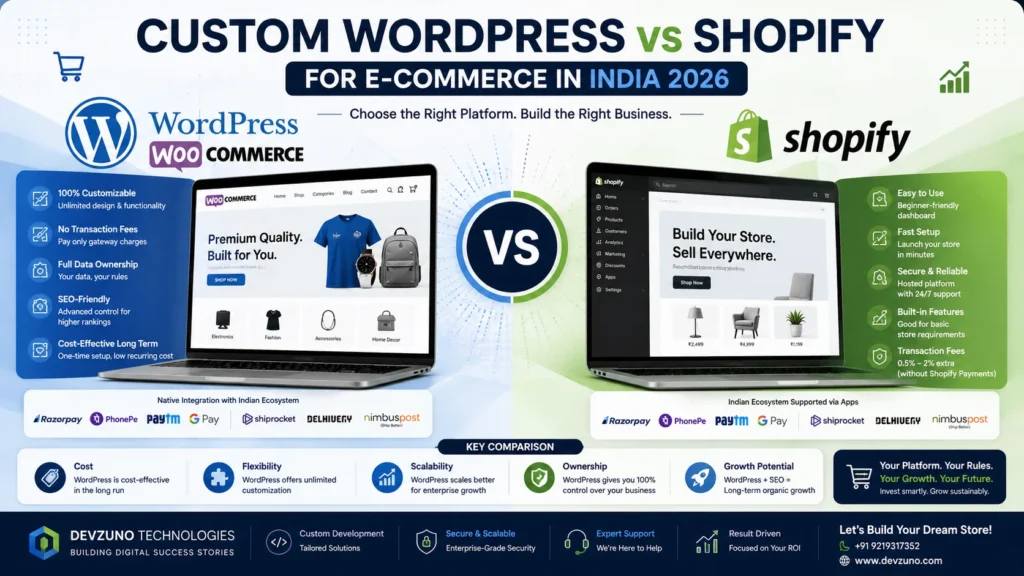
Comparing Custom WordPress vs Shopify for E-Commerce in India (2026 Guide)
Custom WordPress vs Shopify for E-Commerce in India: Quick Comparison
Before diving into detailed technical analysis, here is a quick benchmark comparison table for custom WordPress vs Shopify for e-commerce in India across key parameters for 2026.
| Feature / Parameter | Custom WordPress (WooCommerce) | Shopify |
|---|---|---|
| Initial Setup Cost | ₹30,000 – ₹1,50,000 (One-time dev fee) | ₹2,500/month subscription + dev fee |
| Transaction Fees | 0% extra (Only Payment Gateway fees) | 0.5% – 2.0% extra unless using Shopify Payments |
| Design Flexibility | 100% Unlimited Customization | Template-restricted (Liquid code) |
| Indian Payment Gateways | Native integration (Razorpay, PhonePe, Paytm) | Supported via apps (with extra setup) |
| GST Invoice & Tax Compliance | Automated via free/affordable plugins | Requires paid third-party apps |
| Ease of Self-Management | Requires basic WordPress knowledge | Extremely easy drag-and-drop dashboard |
1. Cost Analysis & Recurring Overhead Breakdown
When evaluating custom WordPress vs Shopify for e-commerce in India, understanding the true long-term financial cost structure is crucial for maintaining a healthy business runway.
Shopify Pricing Model Explained
Shopify operates on a Software-as-a-Service (SaaS) monthly subscription model. According to the official Shopify pricing guide, while it allows non-technical business owners to launch quickly, recurring app subscription fees for basic essential features (such as product reviews, GST invoicing, automated order tracking, and advanced popups) can quickly stack up to ₹10,000 – ₹25,000 per month in unexpected overhead.
Custom WordPress (WooCommerce) Pricing Model Explained
WordPress is open-source software. You pay an upfront development fee for custom UI/UX design, database engineering, and speed optimization. However, your ongoing recurring costs are strictly limited to standard cloud hosting (₹500 – ₹2,000/month) and annual domain renewal. There are zero mandatory monthly platform subscriptions or sales commissions.
2. Payment Gateway & Logistics Integration in India
For D2C brands and retailers operating in India, smooth Cash on Delivery (COD) order verification, automated UPI payments, and seamless shipping logistics integrations are mandatory for success.
When evaluating custom WordPress vs Shopify for e-commerce in India, WordPress offers complete architectural freedom to integrate local gateways like Razorpay, Cashfree, PhonePe, and Paytm with zero extra platform commissions. Shopify, on the other hand, imposes an extra transaction fee percentage on every order processed outside their proprietary checkout ecosystem.
Both platforms support top Indian shipping aggregators like Shiprocket, Delhivery, and NimbusPost effortlessly via official API integrations.
3. SEO & Organic Search Ranking Capabilities
Organic Google search traffic is vital for keeping your Customer Acquisition Costs (CAC) low in competitive markets.
WordPress was natively engineered as a Content Management System (CMS), giving developers granular control over custom URL structures, Schema markup, Core Web Vitals speed tuning, and deep technical blogging architectures.
Shopify handles basic e-commerce SEO well out of the box, but enforces static URL structures (forcing `/products/` and `/collections/` subdirectories into your links) which limits advanced custom technical SEO optimization strategies.
4. Security, Backups, & Store Ownership
Security and data ownership are primary concerns for growing online stores in India. When comparing custom WordPress vs Shopify for e-commerce in India, Shopify manages SSL certificates, server security, and PCI compliance on your behalf. This minimizes maintenance effort but locks your core store data inside a proprietary environment.
With custom WordPress development, you own 100% of your source code, database tables, and customer records. You can migrate your site to any hosting server globally (such as AWS, DigitalOcean, or Hostinger) without platform restrictions or account suspension risks.
5. Scalability & Custom Functionality
As your store scales past 1,000+ daily orders, custom features like tiered wholesale pricing, dynamic loyalty programs, custom product builders, and CRM integrations become essential. Building bespoke functionality into Shopify often requires hiring specialized Liquid developers or paying high monthly SaaS app fees.
Custom WordPress architectures allow full freedom to write custom PHP/JS logic or integrate headless React/Next.js frontends for lightning-fast mobile shopping experiences.
Frequently Asked Questions (FAQs)
Which option is better: custom WordPress vs Shopify for e-commerce in India for beginners?
If you have no technical experience and want to manage product updates entirely by yourself without developer assistance, Shopify is easier initially. If you want 100% full ownership of your customer data, significantly lower recurring fees, custom landing pages, and unlimited functionality, a custom WordPress build is superior.
Can I migrate from Shopify to WordPress later as my store grows?
Yes, your entire product catalog, customer database, and historical order data can be exported via CSV files and seamlessly migrated to a custom WordPress infrastructure at any stage of your business growth.
Need an expert engineering opinion on choosing between custom WordPress vs Shopify for e-commerce in India? Contact the technical development team at Devzuno Technologies today to architect the perfect online store for your business.